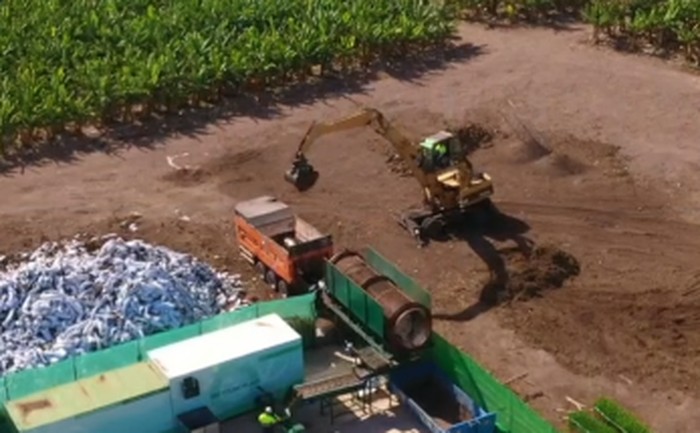
Phase 01
Stabilisation
The organic matter is brought to a stable state. Decomposition stops progressing, so the material no longer degrades, releases gases or generates leachate.

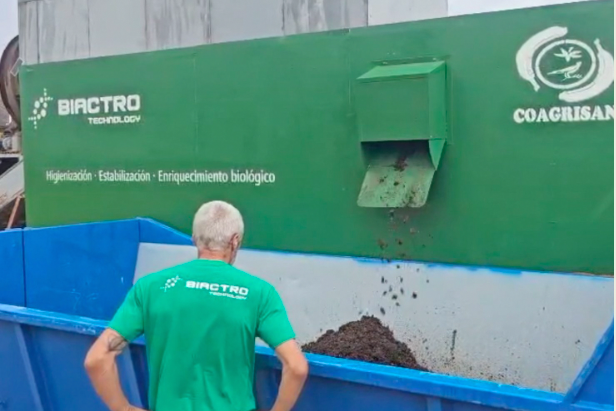
Instead of storing, fermenting or transporting organic residues, the system treats them where they are produced. Emissions are prevented before they form.

The system accepts a wide range of organic residues.
Material is processed on the site where it is generated. There is no long-term storage, no lagoon dependency and no waiting period. That alone removes the conditions in which methane, ammonia, odour and leachate form.
The ecosystem works on the same principle as a biological digestive tract. Organic matter passes through successive stages, each doing a distinct job, in a continuous flow rather than in batches. The material never stops moving, and it never accumulates.
The organic matter is brought to a stable state. Decomposition stops progressing, so the material no longer degrades, releases gases or generates leachate.
Pathogens and harmful microorganisms present in the incoming material are neutralised, producing an output safe to handle and safe to apply directly to land.
Nutrients and organic compounds are preserved rather than lost, and the output is returned as a homogeneous material rich in beneficial microbiota.
Because the process runs continuously and does not depend on a fermentation phase, there is no accumulation of unstable material at any point in the cycle.
No curing, composting or secondary treatment is required. Unlike digestate or raw compost, the material does not degrade further, emit gases or create sanitary risk.
No residual waste streams. No liquid fraction requiring disposal. No off-site processing.
Everything entering the system is transformed and returned to productive use. This is what makes the system genuinely circular rather than partially circular.
The ecosystem has treated organic waste at industrial volume in Europe since 2019, in continuous operation.
ReSoil deploys this already-proven system in the United Kingdom, aligned with national regulations, planning frameworks and environmental objectives.